There are a lot of legends surrounding this name. The town was originally known as Reeseville. Some say the town was named for King Frederick of Prussia who was a supporter for the American Colonies during the Revolutionary War. Another legend says a local tavern and inn owner from Reeseville by the name of Jimmy Berry named the town. During the Revolutionary War, Berry was a British sympathizer but a shrewd businessman. When Berry heard there were wealthy Prussian troops with George Washington at Valley Forge, he hung a “King of Prussia” sign out on his establishment welcoming the Prussians to come and spend their money with him. The innn became known as the King of Prussia Inn located in Reeseville. Later, early surveyors mistakenly looked at the large sign on the inn and recorded “King of Prussia” as the name of the town instead of Reeseville.
Photo courtesy of Library of Congress
Wednesday, November 11, 2009
Tuesday, November 3, 2009
Nothing "Ordinary" about Virginia!
Ordinary, Virginia
By 1668, ordinaries were so common in Virginia that laws were being established to limit how many could operate in a town or village. Although an ordinary was defined as a combination of a general store and an inn, they were really popular places for patrons to drink beer and ale. By the early 1700’s, the word “ordinary” was rarely used. These places were now known as taverns. Ordinary, was chosen as the name for this Virginia community because of its tradition of having so many ordinaries or taverns located in the area. Again, an "ordinary" name has changed in meaning to us after many years of transition.
Tuesday, October 20, 2009
Bowlegs, Oklahoma is OK
Bowlegs, Oklahoma named after a Great Chief!
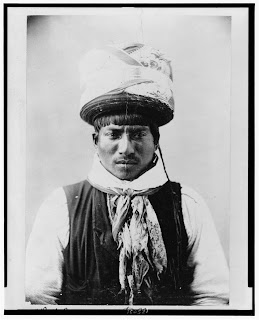
Bolek, also known as Billy Bowlegs, was a fierce Seminole Chief from Florida. After signing a treaty in 1832, Bowlegs and his 200 warriors were peaceful until his fellow Seminole Chief Osceola was wrongfully imprisoned. Chief Bowlegs and his warriors led many successful raids against the U.S. Military. Finally in 1858, the government convinced Chief Bowlegs to relocate to the new Indian Territory in Oklahoma. He was given $10,000 dollars and each of his followers received $1,000. Here he became a prominent chief to his people and was once again peaceful. During the Civil War, he became a captain in the Union Army and was instrumental to the success in this region against the Confederacy. In 1864, the famous chief died of smallpox.
Photo Courtesy of Library of Congress
Saturday, October 3, 2009
Toad Suck, AR - Yes, It does exist!
Toad Suck, AR
Located on the Arkansas River, Toad Suck claims one of the most unique legends. Way back when, this is where the river captains and their crews chose to relax. Along with the river traffic came many questionable characters. Drinking was often the recreation for both the staff of the river industry and the shady people who hung out in this area. Early settlers in this area observed the excessive drinking going on in this area and named the drinking patrons as “Toad Sucks”. They exclaimed that “these people sucked on their whiskey and swelled up like toads”! The area became known as “Toad Suck”. Today, a state park is nearby and many of the locals in the area come here during weekends to picnic and go fishing. You will also find a local convenience store nearby with some very unique “Toad Suck” merchandise!
Tuesday, September 15, 2009
The story from HELL!
Hell, Michigan
George Reeves established a community here in 1838. George also ran a whiskey still and got some of his neighbors in trouble. Their wives would often exclaim that their husbands had gone to Hell” (referring to George’s still) where they would hang out and drink with George. In 1841, the State of Michigan asked George what was going to be the name of his new town. George exclaimed “Call it Hell, everyone else does”. The name was accepted! Excessive drinking was a growing concern in the early growth of the United States. Often, people associated the drinking of any alcohol as a devilish behavior. The temperance movement became a prominent national movement by the end of the 19th century. By the way, it does get cold here in the winter and Hell does occasionally freeze over!
Photo courtesy Library of Congress
Sunday, August 30, 2009
Neptune City - Swallowed up by another town!
Neptune City, New Jersey
As the United States grew so did the imagination of our ancestors with the names of their new communities. In 1881, the citizens in this community chose a Greek god for their town’s name. The town is located near the Atlantic Ocean and much of the economy at the time was based upon the ocean traffic. Neptune being the Greek god of the ocean seemed to be a logical choice. During this period, it was not unusual for towns to be named after mythical gods or legends. Other communities used names like Hercules, Venus, Jupiter and even Mars as names. Neptune City grew tremendously in land area. In 1900, the New Jersey legislature annexed much of the city and created a new township. Oddly enough, the town that swallowed up the land from Neptune City was named “Avon by the Sea”! The name “Avon” is a Welsh term meaning “river”.
Photo Courtesy of Library of Congress
Monday, August 17, 2009
Tuxedo, NY and the Tuxedo

In 1886, Pierre Lorillard IV built an exclusive country club here. He named it the “Tuxedo Club”. It was a private country club and only exclusive socialites were included in its membership. One of its members was wealthy millionaire, James Potter. Potter was friends with Edward VII of England, the Prince of Wales. The Prince fancied Potter’s wife, Cora, and invited both of them to come visit him in England. Potter was impressed with Edward’s smoking jacket. The Prince replied that it was manufactured by the Henry Poole Company in England and that the company had exclusively designed it for him. Potter liked the Prince’s suit so well that he had a duplicate made. When Potter returned to his hometown to show it off, his wealthy friends at the Tuxedo County Club were ecstatic. It was such a hit that all of the country club members started sporting this new fashion in apparel and the tuxedo became the popular attire for the club’s social events. Later, other wealthy American socialites joined in on the new fashion. However, no one knows for sure how impressed Cora Potter was with the Prince of Wale’s tuxedo. I guess only the Prince and Cora know!
Photo courtesy of Library of Congress

Subscribe to:
Posts (Atom)